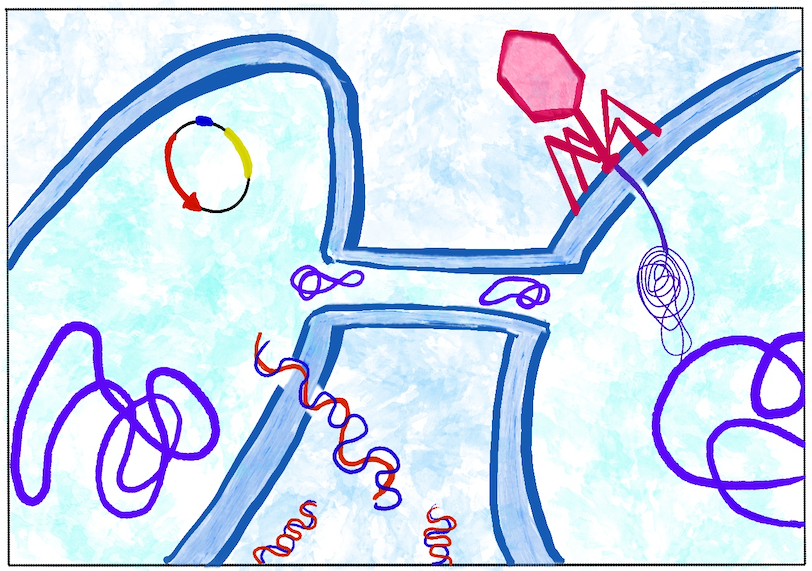
My research has focused on understanding the drivers of microbial diversity and community structure and how microorganism adapt to environmental stress, with a particular emphasis on the role of mobile genetic elements (MGEs), viruses, and host–microbe interactions.
I have employed integrative omics approaches, primarily metagenomics, amplicon sequencing, and metaproteomics to explore microbiomes from both natural and host-associated environments. My research has encompassed projects investigating the human, chicken, fish, and pig gut, as well as the rumen of cows and sheep. Additionally, I have studied dessert and agronomic soils.
Viral ecology and microbiome interactions
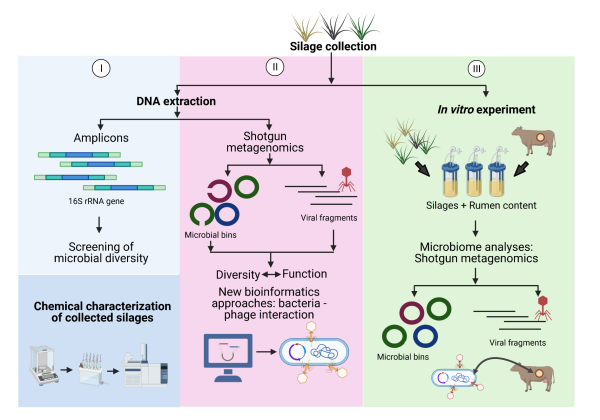
A growing part of my research is driven by my interest in understanding how viruses, particularly bacteriophages, shape microbial ecosystems. I am especially interested in how viral–host interactions influence community structure and dynamics, and how these interactions change across environments. To explore this, I use metagenomics together with a range of bioinformatic tools to reconstruct viral genomes and investigate virus–host relationships.
Using this approach, I have recovered viral genomes from silage, cattle rumen and faeces, and the chicken gastrointestinal tract. What I find particularly interesting is the vast and largely unexplored viral diversity present in these systems. At the same time, viral populations appear to be closely linked to the structure of the bacterial community, but also shaped by environmental factors such as gut region, pH, temperature, and diet. Despite this, many of these viruses remain poorly described, and I am particularly interested in moving beyond sequence-based approaches to isolate both viruses and their hosts. Another aspect that motivates my work is understanding how microbes defend themselves against viral infection. To explore this, I have characterised the diversity of antiviral defence systems in the rumen microbiome, revealing a highly diverse and unevenly distributed “pan-immune” repertoire across microbial genomes. I am interested in how this diversity reflects ongoing viral pressure, and why some taxa appear to invest more heavily in defence than others.
By combining viral genome reconstruction with the study of host defence systems, I aim to better understand how viruses and microbes co-evolve, and how these interactions contribute to the structure, function, and stability of microbial communities.
Microbial adaptation and mobile genetic elements
A central theme of my work is my interest in how mobile genetic elements (MGEs) shape microbial adaptation across different environments. I am particularly interested in understanding when MGEs act as long-term evolutionary drivers and when they facilitate rapid, short-term responses. In extreme environments such as the Atacama Desert, I found that MGEs are enriched and often associated with genes involved in core cellular processes such as replication, transcription, and energy metabolism. This pattern suggests to me a role in long-term adaptation, where these elements become more integrated into the host genome rather than acting as transient agents of change. Interestingly, this pattern does not seem to be consistent across all systems.
In contrast, in a host-associated system such as the gut microbiome of fish exposed to antibiotics, I observed that MGEs can contribute to the rapid spread of antibiotic resistance genes. This highlights their role in short-term adaptive responses under strong and rapidly changing selective pressures, where gene exchange can provide an immediate advantage.
These observations have led me to explore the idea that the function and dynamics of MGEs are strongly shaped by the type of environmental stress. Also the genes carried and recruited by MGEs would depend not only on the nature of that stress, but also on the timescale over which it acts.